
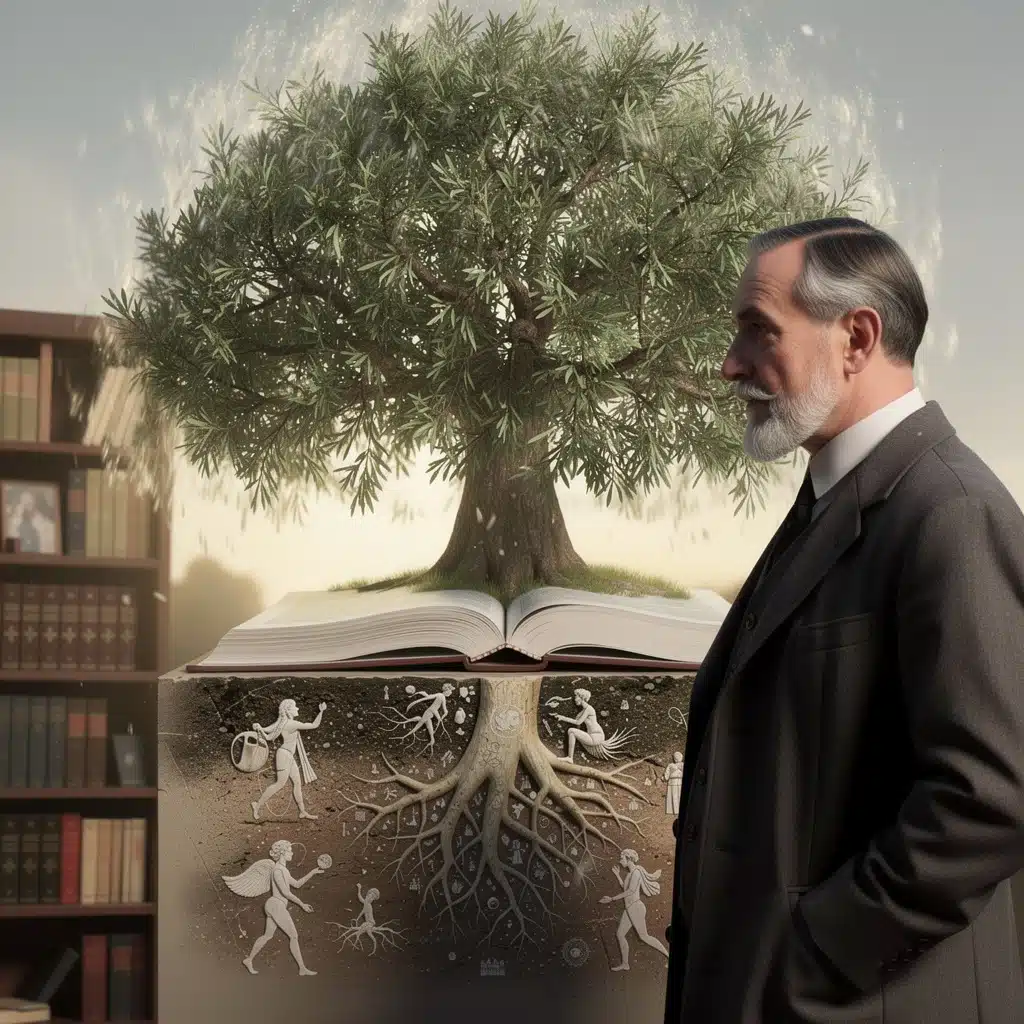
The phrase sounds strange at first. The philosophical tree. It seems to unite two worlds that have no business together — the vegetable world, silent and patient, and the world of abstract thought.
Yet Jung devoted one of his longest and most demanding studies to this theme — nearly two hundred pages in The Roots of the Unconscious. This was no scholar’s caprice. Behind this formula lies something essential to his vision of the human being.
To understand what Jung means by it, we need a brief detour — short, we promise — into the world of alchemy.
Table of Contents
Alchemy: Not Gold, But Soul
When we speak of alchemy, the image that comes to mind is usually one of bearded old men attempting to turn lead into gold in smoky cellars. Jung sees something else entirely.
For him, medieval alchemy is not a failed proto-chemistry. It is an extraordinary reservoir of psychic symbols. The alchemists — whether they knew it or not — were not describing chemical reactions. They were projecting the movements of their own souls onto matter: putrefaction, purification, transmutation. The Great Work was not the manufacture of gold. It was the inner transformation of the one who sought it.
This discovery thrills Jung. He writes in Memories, Dreams, Reflections that alchemy gave him the “historical link” he had been searching for — proof that his own intuitions about the unconscious were rooted in a millennial tradition, shared by people who lacked the vocabulary of psychology but already possessed its images.
And among those images, one kept returning: the tree.
The Tree of the Philosophers
In alchemical vocabulary, the word “philosopher” does not refer to an intellectual shut away among books. It designates the adept — one initiated into the secrets of nature, seeking to understand the living forces that animate matter and transform it.
For these philosophers, the tree was a central metaphor for their work. It referred at once to the matter being transformed, to the process itself, and to its outcome. The philosophical tree is alive. It grows, it branches, it bears fruits — or stars, depending on the illustration. And in this growth, the alchemists saw the reflection of something happening inside the human being.
What fascinates Jung is that his own patients — who had never opened an alchemical treatise — spontaneously drew trees in their inner productions: trees planted in human bodies, inverted trees, trees covered in flames or serpents. The image rises up on its own, from the depths of the collective unconscious, as though the tree were a natural way for the psyche to represent itself.
Man as an Inverted Tree
One of the most striking images Jung encounters in his research is that of the inverted tree. It appears in the Middle Ages but also in the most ancient Hindu texts: the human being is a tree whose roots are turned toward the sky and whose branches reach down toward the earth.
This inversion says something precise. If the roots of an ordinary tree plunge into nourishing earth, the roots of the human being plunge into something invisible — the unconscious, the spiritual, what exceeds individual consciousness. And his branches spread into the visible world: action, daily life, outward expression.
Jung cites an unexpected vegetable image in this connection: the asparagus shoot. This tip piercing the soil with quiet force strikes him as a perfect representation of “the inner growth of previously unconscious contents passing into consciousness.” What was underground rises. What was dark becomes visible.
The growth is not spectacular. It is slow, stubborn, continuous. Like a tree.
The Tree’s Growth as Mirror of the Psyche
At the close of his long journey through alchemical texts, his patients’ drawings, and shamanic traditions, Jung arrives at a formulation of remarkable clarity. He gathers into a few sentences everything he has been seeking to say:
“The whole of this process, which we today would see as psychological development, was described under the name of the ‘philosophical tree’ — a poetic comparison that rightly draws an analogy between the natural phenomenon of the psyche’s growth and that which concerns plants.”
— Carl Gustav Jung, The Roots of the Unconscious
What Jung calls “individuation” — the long work of a lifetime, consisting of becoming what we truly are in our full psychological wholeness — resembles the growth of a tree. Not a planned project, not a conscious will deciding its own development. Something grows within us, independently of our intentions, from roots we have not chosen, toward a form we cannot entirely foresee.
The tree does not decide to grow. It grows.
And it is precisely this dimension — spontaneous, natural, greater than the ego — that the alchemists had perceived before modern psychology, in their language of fire and stone.
What the Tree Accomplishes That We Dare Not
There is something in Jung’s vision that goes beyond personal development in the contemporary sense. The philosophical tree is not a self-improvement program. It is an image of wholeness.
The tree is complete: its roots in darkness, its trunk in visible time, its branches reaching toward what exceeds it. It does not separate life from death — leaves fall, wood becomes humus, and from that humus something else is born. The cycle is whole.
We, by contrast, separate. We want growth without decline, youth without aging, life without what it inevitably announces. Jung sees in this the source of a great collective neurosis — a subject he explores more directly in what we examined in our article on Jung and death.
The philosophical tree proposes another posture: to accept being a whole being, whose growth includes the return to the earth.
A Very Ancient Gesture
It is striking that across many human traditions — long before medieval alchemy, long before Jung — planting a tree at a grave was a natural, almost instinctive act. Not from superstition. But because something in human consciousness knew that death is not the end of growth. That something continues to push upward.
This gesture, Jung would have recognized as profoundly right. The psyche has never truly forgotten it.
0 Comments