
In this article
Discover our biodegradable urns →
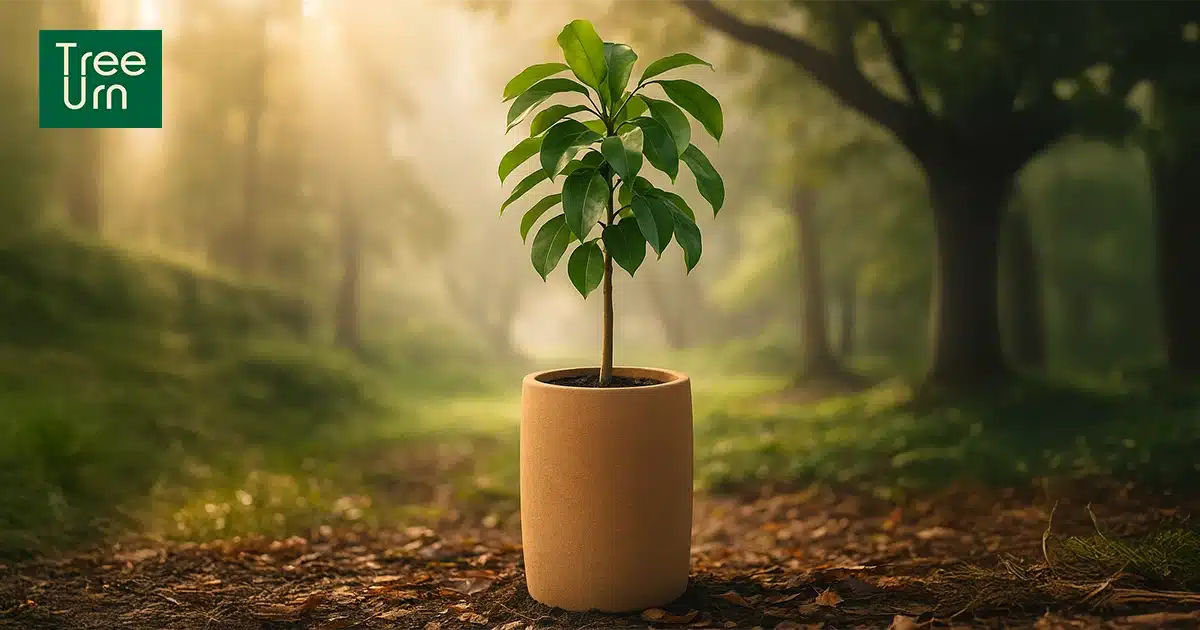
Tree Urn is a medium-term biodegradable cork urn designed for the scattering of ashes. Rather than a fixed, enclosed memorial, it offers something alive — a tree that grows from the same earth that receives the ashes, in a place chosen with intention and love.
The urn naturally decomposes within 6 to 8 years. Over that time, the ashes are gradually integrated into the roots and then dispersed into the surrounding soil. What remains is not a grave — it is a tree, standing in a place that matters.
“Scattering ashes is not an absence. With Tree Urn, it becomes a presence — rooted, growing, alive.”
1. Legal positioning: a scattering urn, not a burial
Because the Tree Urn biodegrades completely over 6 to 8 years and releases ashes progressively into the soil, it is legally considered a scattering urn in most countries — not a burial. This distinction has important practical consequences.
- It does not create any official funeral site or commemorative monument.
- No cemetery registration, no burial permit — the process follows ash scattering regulations.
- After several years, no urn remains — only the tree, like any other tree growing in the ground.
This legal framework gives families significant flexibility in choosing where to plant the urn, while remaining fully compliant with local regulations.
Read our complete guide to ash scattering laws in Europe →
2. Where can a Tree Urn be planted?
The choice of location is one of the most meaningful decisions in the entire process. A garden that was loved. A hillside they walked. A corner of a forest where they felt at home. Tree Urn gives families the freedom to choose — within the framework of local regulations.
On private land
Planting is permitted when the landowner freely consents. A private garden, a family property, or a rural estate can all serve as resting places — intimate, accessible, and deeply personal.
In a memorial or ecological forest
Dedicated memorial forests and ecological cemeteries are specifically designed for biodegradable urn burials. These spaces offer legal security, professional management, and a serene natural environment.
In a natural area
Forests, meadows, mountain areas, and natural coastal zones can be considered — subject to local authorisations, which vary by country and region. Uncultivated private land, with the landowner’s consent, often offers more flexibility than public spaces.
“The tree does not belong to a cemetery. It belongs to the landscape — and to the memory of the person who nourished it.”
Read our practical guide to memorial forests and burial sites →
3. Symbolic and practical consequences
Choosing Tree Urn as a form of scattering carries a different weight from traditional burial. It is worth understanding what this means in practice.
The tree that grows is a tree like any other. It carries no funeral rights, no legal obligations for future owners of the land. If the property is sold or the land changes hands, only the tree remains — without any official status as a burial site. This is precisely what makes it so free.
For many families, this freedom is not a limitation — it is a philosophy. No attachment to a fixed place, no maintenance contract, no concession to renew. The memory lives in the tree, wherever it grows, for as long as it stands.
Read: The true nature of Tree Urn — how it transforms life →
4. Why choose Tree Urn for scattering ashes?
Legal compliance
Tree Urn fits within the framework of ash scattering regulations in most countries, making it a legally straightforward choice that avoids the complexities of formal burial.
Flexibility
The freedom to choose the place of implantation — a garden, a forest, a hillside — means the memorial can be as personal and meaningful as the person it honours.
Simplicity
No cemetery formalities, no monument registration, no ongoing obligations. The process is as simple as planting a tree.
A natural legacy
Ashes returned to the earth. A tree that grows. A living symbol of continuity — for those who remain, and for those who come after.
Read our guide: Ceremony Ideas for Ash Scattering →
5. Frequently asked questions
Is Tree Urn considered a grave?
No. Tree Urn is a scattering urn. It does not create an official funeral site, a burial concession, or any legal obligation associated with a grave.
What remains after 10 years?
Only the tree. The cork urn fully biodegrades within 6 to 8 years, leaving no trace in the soil beyond the nourishment it provided to the roots.
Do I have to put all the ashes in the Tree Urn?
This is your free choice. Only part of the ashes may be placed in the urn, with the remainder scattered or kept elsewhere. However, some countries require all ashes to be placed in a single urn — always check the legislation applicable in your country before proceeding.
Can I plant a Tree Urn indoors or on a balcony?
Yes. A large planter with good drainage works perfectly — allowing the living tribute to remain close to home, wherever you are.
0 Comments