
In this article
Discover the Tree Urn collection →
Tree Urn is not just a funeral urn — it truly accompanies each person through the grieving process, step by step. This gradual progression is what makes it so unique. While other urns merely contain the ashes, Tree Urn involves the person in an active, tangible, and symbolic process that helps transform loss into a new form of life.
1. A unique support to journey through grief
Most funeral urns are passive objects — they hold ashes, and they stay. Tree Urn is fundamentally different. It is designed not to remain, but to act. From the first moment you hold it in your hands to the day you plant it in the earth, each gesture is part of a deliberate sequence that supports the mourner through one of the most difficult transitions of human life.
“While other urns merely contain the ashes, Tree Urn involves the person in an active, tangible, and symbolic process.”
2. A process based on personal involvement
Carrying out each step yourself creates a direct psychological engagement. This process follows the logic of what Paul-Claude Racamier described as “The Primal Mourning” — one of the stages he identified is to build life out of loss, transforming absence into a creative movement.
That is precisely what Tree Urn enables: an active process that engages the person through a concrete gesture, offering a real and embodied transition from death to life.
Explore the major grief theories in depth:
Read: Understanding Grief: Major Psychological and Psychoanalytic Theories
3. A progressive discovery
Tree Urn was not originally designed as a psychological tool for processing grief, but rather as a way to release the fear of death by symbolising life. Over time — through experiences, exchanges, and feedback from bereaved families — it became clear that the urn is in fact a powerful therapeutic companion that concretely supports the grieving process.
This discovery was gradual, honest, and grounded in real human experience. It is not a marketing claim — it is an observation made step by step, through listening.
4. The importance of grief
Although grief is painful, it is an essential process for the structuring of the psyche and the individual’s development. A true originary work, it accompanies human growth from the earliest stages of life, passes through all phases of existence, nourishes family and cultural dynamics, and only ends with death — to then be transmitted to those who remain.
It thus opens a space for growth and transformation. Grief is not the enemy of life — it is a passage toward it.
“Grief is not the enemy of life. It is a passage toward it.”
Why grief matters — a deeper look:
Read: The Importance of Grief in Our Lives
5. The five steps of the process with Tree Urn
The Tree Urn process is structured around five meaningful gestures. Each one builds on the last, creating a progression that guides the mourner from loss toward renewal.
Step 1 — Receiving the urn
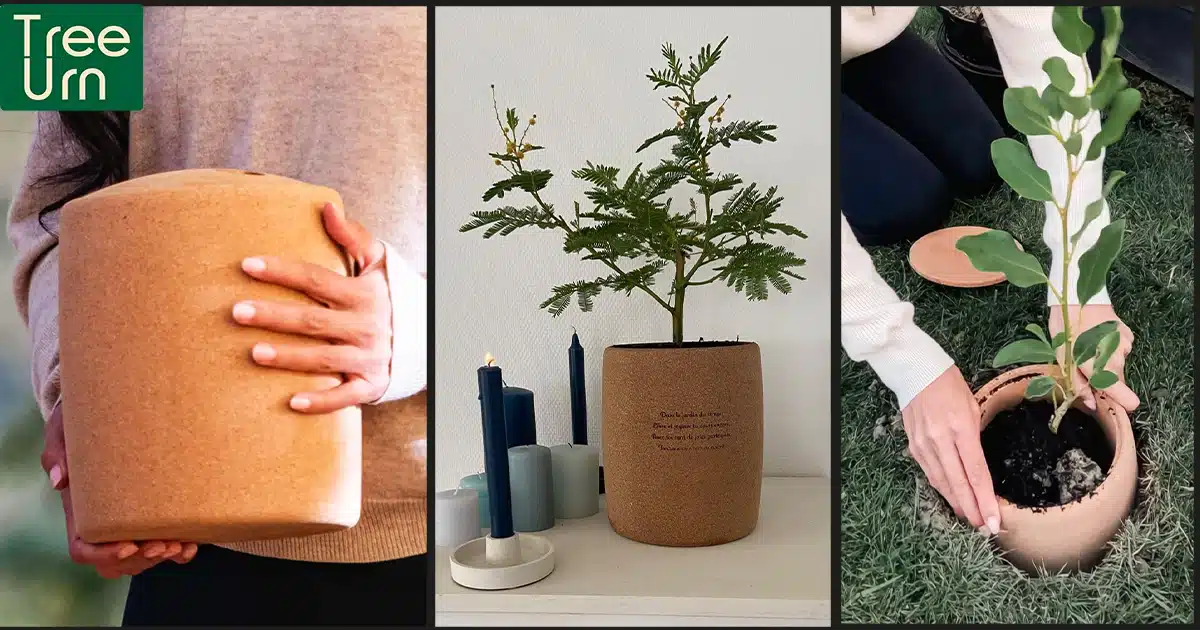
From the very first contact, Tree Urn creates a different experience. Cork — a natural and warm material — brings a comforting, intimate, and gentle sensation. Unlike most urns, which are cold, hard, or impersonal, Tree Urn immediately conveys an emotional and soothing dimension.
Step 2 — Writing a message
The urn can be personalised. You may write a name, a word, or a message directly on its surface with a marker, if this wasn’t already requested during the order. This simple act encourages personal expression and helps put emotions into words. It is also possible — and even recommended — to write a letter to place inside the urn, to freely express thoughts or words you wish to share with the departed.
Step 3 — The time of vigil
The urn can be kept for a while at home, accompanied by candles for a memorial vigil — a quiet and intimate moment of remembrance. This stage allows one to maintain a symbolic connection with the soul and memory of the deceased, to express thoughts before saying goodbye.
Step 4 — Planting the tree: the passage to life
The act of planting a tree within the urn is the key moment. This gesture — concrete and visible — symbolises the transformation of death into life. Here, the tree becomes part of the process, and this tangible act directly affects the psyche: it marks the transition from mourning to reconstruction.
Planting the tree means transferring attachment — moving from the memory of death to the visualisation of life. The mind cannot bear emptiness: to detach from an idea or a memory, it must be replaced by another. Tree Urn allows precisely this — replacing the pain of loss with the living presence of growth.
Step 5 — Letting go
The final step is the burial of the urn. This moment represents letting go — the acceptance of departure. It symbolises the release of the soul of the deceased, now free to move on in peace, while the living reconnect with life through the growth of the tree. This step marks the completion of the process, and the beginning of a new one.
“Each gesture carries meaning — restoring to death its constructive dimension as a passage toward life.”
Six approaches to help navigate grief:
Read: Coping with Grief: 6 Therapeutic Approaches to Overcome It
6. An idea born from experience
Tree Urn was not born from a marketing concept. It grew gradually, through the founder’s experience, human interactions, and real-life observations. Step by step, it evolved into a psychological and symbolic tool, offering everyone a concrete, simple, and natural way to journey through grief.
How grief is experienced across different cultures:
Read: Mourning Across Cultures & Traditions
7. A true gift of nature and meaning
Tree Urn offers a unique gift: the opportunity to experience grief naturally, humanly, and peacefully. Each gesture carries meaning, restoring to death its constructive dimension — that of a passage toward life. By connecting matter, action, and symbolism, Tree Urn transforms grief from an end into an act of personal growth.
References: Paul-Claude Racamier — The Primal Mourning (Le deuil Originaire). BSF — The Sigmund Freud Library of the Paris Psychoanalytic Society.
Discover the Tree Urn process →
Frequently Asked Questions
What is Tree Urn?
Tree Urn is a biodegradable funeral urn that guides people through grief by inviting an active, symbolic journey from loss to new life through planting a tree.
How does Tree Urn support the grieving process?
It structures grief into five meaningful steps — receiving the urn, writing a message, a vigil, planting the tree, and letting go — creating concrete actions that help transform grief into renewal.
Is Tree Urn a psychological therapy?
No. It is not a medical treatment. It is a symbolic, experiential process that many families find supportive. Use it alongside professional care if needed.
What materials is the urn made from?
Cork and biodegradable binder, designed to return naturally to the earth as the tree establishes roots.
Can Tree Urn be used for pets?
Yes. Families often use Tree Urn for companion animals with the same meaningful steps and rituals.
Where can the tree be planted?
On private land with permission, in memorial gardens, or in cemeteries that allow tree burials. Always check local regulations first.
What tree species should be chosen?
Select species adapted to your climate and soil. Native or locally recommended trees are ideal — ask a local nursery or arborist. Tree Urn advises choosing a tree or green plant from a local nursery in your region.
How can the urn be personalised?
You can write a name or message on the cork surface and place a private letter inside the urn as part of the ritual.
What does the vigil involve?
Some families keep the urn at home briefly with candles, photos, music, or readings — a quiet time to remember before the farewell.
What does planting the tree symbolise?
It marks the tangible passage from death to life, helping shift attachment from loss to the living presence of growth.
What if the tree doesn’t survive?
The risk is extremely low thanks to Tree Urn’s unique natural process, designed to support healthy growth. However, nature remains unpredictable — and even if the tree were not to thrive, the urn would still decompose naturally, allowing the ashes to return to the earth and nourish new life.
Is Tree Urn compatible with different beliefs and cultures?
Yes. It is non-denominational and adapts to secular, spiritual, or religious ceremonies and family traditions.
It’s simply incredible to see how, with such simplicity, this Tree Urn process helps you get through the ordeal of grief. Of course, you still have to be able to open yourself up to what is offered to you in order to gain your freedom and grow. We remain the architects of our own lives.