
In this article
Discover our biodegradable urns →
Spain offers families a genuinely broad set of options for the final destination of ashes — from scattering in natural landscapes and at sea, to burial in cemetery gardens, private land, and living memorials with biodegradable tree urns. The framework is permissive, but locally regulated: national guidance sets the principles, while municipalities and Autonomous Communities determine the specific conditions.
This guide brings together everything families and professionals need to know — clearly, and without the legal jargon.
“Spain’s landscapes — its forests, coastlines, and sun-drenched sierras — make the choice of a natural farewell feel not just possible, but deeply right.”
1. The legal framework: who regulates ashes in Spain?
Mortuary health in Spain is a shared competence between the central State and the Autonomous Communities. The national Mortuary Health Consensus Guide (Guía de Consenso sobre Sanidad Mortuoria), updated in July 2025, sets out the officially recognised destinations for ashes:
Custody by a private individual — keeping ashes at home is legal.
Burial in funeral structures or columbaria — the traditional cemetery option.
Burial in authorised ground — including biodegradable urns in designated spaces.
🌬️ Scattering in authorised places — subject to municipal and regional rules, and applicable environmental law.
Because scattering regulation is primarily local, it is essential to verify the relevant ordenanza municipal (municipal ordinance) and, where applicable, the regional Policía Sanitaria Mortuoria decree before proceeding. Fines may apply for non-compliance, particularly in protected natural areas.
Read our full guide to ash scattering laws across Europe →
2. Where can ashes be scattered in Spain?
Scattering is legal in Spain when duly authorised and when it poses no public health or environmental risk. Here are the main options:
Public and natural spaces
Scattering in parks, forests, and open countryside is permitted in principle, but many municipalities restrict it in busy urban areas and protected natural zones. Always obtain municipal permission and follow any location or timing guidance issued by the local authority.
At sea
Sea scattering is possible via licensed maritime operators and in compliance with navigation and environmental regulations. Local authorisation is typically required. This remains one of the most emotionally meaningful options for families with ties to the coast.
Private land
Scattering on privately owned land is possible with the written consent of the landowner and subject to any applicable local restrictions. This is often the simplest route for families with a garden or rural property.
3. Cemetery and memorial site options
Spanish cemeteries increasingly offer dedicated options for cremated remains, beyond the traditional columbarium niche. Common legal destinations include:
Urn burial in a family grave or new plot.
Columbarium — a dedicated niche for urns within cemetery structures.
Garden or forest areas — designated zones for scattering or tree-based memorialisation, available in a growing number of Spanish cemeteries.
Availability and conditions vary significantly by municipality. Contact your local cemetery administration directly to confirm which options are currently offered.
4. Tree Urn: a natural and biodegradable alternative
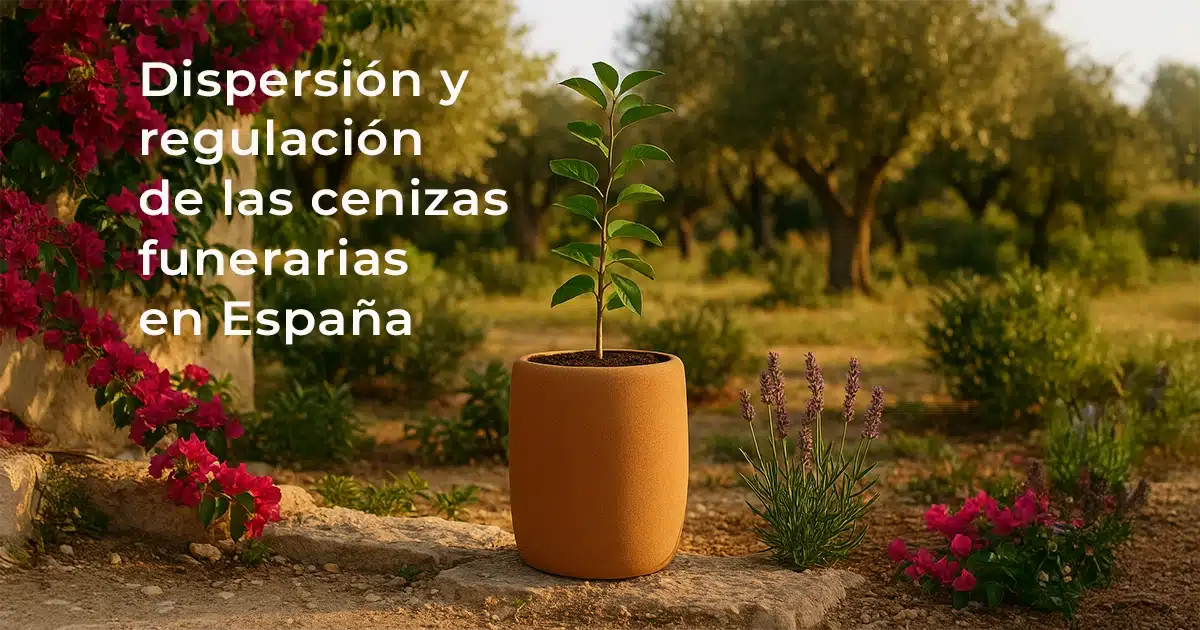
A biodegradable tree urn offers something no columbarium can: a living memorial that grows, breathes, and changes with the seasons. Under Spanish law, this practice is generally considered a form of scattering rather than permanent burial, given that the urn gradually decomposes and releases the ashes into the surrounding soil.
Progressive return to nature
The Tree Urn decomposes in soil over approximately 6–8 years, gradually releasing the ashes and naturally moderating their alkalinity — protecting the young tree’s roots during the critical establishment phase.
Garden, forest, or balcony
The urn can be planted in a private garden, in a dedicated memorial forest, or even in a large pot on a balcony — creating a living presence that can remain close to home.
100% natural materials
Made from natural cork and fully biodegradable components, the Tree Urn leaves no pollutants in the soil. No metals, no synthetic materials — nothing that nature cannot absorb.
“A tree does not mark the end of a life — it continues it. Every leaf, every season, every year of growth carries something of the person who nourished it.”
Read our dedicated article on the biodegradable and compostable funeral urn →
5. Memorial forest sites in Spain
For families seeking a fully managed, legally secured space dedicated to biodegradable urn burials, several memorial forest initiatives operate across Spain:
Parc Roques Blanques — Barcelona (El Papiol)
A pioneering memorial-nature cemetery within a natural park, offering dedicated tree burial areas: Árbol Familiar, Bosque de la Calma, and Camino del Bosque. Biodegradable urns are buried under native woodland species in a serene, protected environment.
Recordarium – Bosque del Recuerdo — Madrid area (Méntrida, Toledo)
A private memorial forest offering tree planting with biodegradable urns, optional scattering zones (lakes, meadows), and outdoor ceremonies. Available through some funeral insurance providers.
Recordar Mi Árbol — Segovia
A private reforestation forest where biodegradable urns are planted with a tree, combining tribute and ecological contribution to the Castilian landscape.
Jardín del Recuerdo — Málaga (Cementerio de San Gabriel)
A municipal memorial garden where families can deposit ashes at the base of a selected tree, within a carefully documented botanical setting.
Bosque de las Cenizas — Córdoba (Ntra. Sra. de la Fuensanta)
A cemetery-managed ash forest offering a green remembrance area within the cemetery grounds.
Availability, fees, and precise conditions vary by site. Contact each operator directly to confirm current rules and biodegradable-urn compatibility.
6. Rules for pet ashes in Spain
Pet remains in Spain are subject to public health regulations and EU animal by-product rules (Regulation EC 1069/2009 as implemented in Spain). The rules differ significantly from those governing human ashes.
Authorised cremation
Individual or collective pet cremation is widely available across Spain through authorised facilities. This is the most legally secure option and is actively encouraged by authorities.
Home or field burial: use caution
Burying a pet on private property or in open land is often restricted or prohibited — particularly in urban settings, protected zones, or water-source areas. Always verify your local ordinance before proceeding. Fines can be significant.
Memorial forests for pets
Several of the memorial forest initiatives listed above — including Recordarium and Recordar Mi Árbol — explicitly welcome pets as well as humans, using biodegradable urns for tree planting in dedicated areas.
Municipal pet spaces
An increasing number of Spanish municipalities are developing dedicated pet areas within their cemetery services. Bilbao, for example, has included a pet space in its new funeral regulations (2026).
7. Finding Tree Urn in Spain
Tree Urn products are available across Spain through our official distribution network:
Official distributor: CIDAF
CIDAF is our official partner in Spain, supporting funeral professionals and families across the country.
Find a retailer near you
Use our store finder to locate your nearest Tree Urn stockist: treeurn.eu/find-a-shop
8. Frequently asked questions
Is scattering ashes legal in Spain?
Yes, when authorised under local rules. Spain’s national guidance recognises scattering as a lawful destination for ashes, but municipalities and Autonomous Communities set the specific conditions. Always verify the local ordinance before proceeding.
Can I scatter ashes in a public or natural space?
Often yes, if authorised and with respect for public health and the environment. Busy urban areas and protected natural zones are commonly restricted. Follow any location or timing guidance issued by the local authority.
Is sea scattering allowed in Spain?
Yes, typically via licensed operators and in compliance with maritime and environmental requirements. Local authorisation is generally required.
Can I place ashes on private land?
Yes, with the landowner’s written consent and subject to any local restrictions applicable in your municipality.
Is a biodegradable tree urn considered scattering under Spanish law?
Generally yes. A biodegradable urn that decomposes in soil and releases ashes progressively is treated as a form of scattering rather than permanent burial under Spain’s current regulatory framework.
Why choose a biodegradable urn over immediate scattering?
The urn’s gradual decomposition (approx. 6–8 years) moderates the alkalinity of the ashes, protecting the young tree’s root system during its establishment phase — ultimately enriching the soil rather than stressing it.
Can I plant a Tree Urn in a pot at home?
Yes. A large planter with good drainage allows the memorial to remain close to home, on a balcony or terrace, while fully respecting ecological principles.
What are the rules for pet ashes in Spain?
Pet remains must be handled through authorised services. Home or field burial is often restricted or prohibited. Memorial forest initiatives and authorised pet cremation services are the legally secure routes.
Do I risk a fine if I scatter without permission?
Yes. Municipal and environmental authorities may issue fines, particularly in protected areas. Always verify the applicable local rules before proceeding.
0 Comments