
In a sector as sensitive and symbolic as funerals, innovation must be approached with humility, responsibility, and a long-term vision.
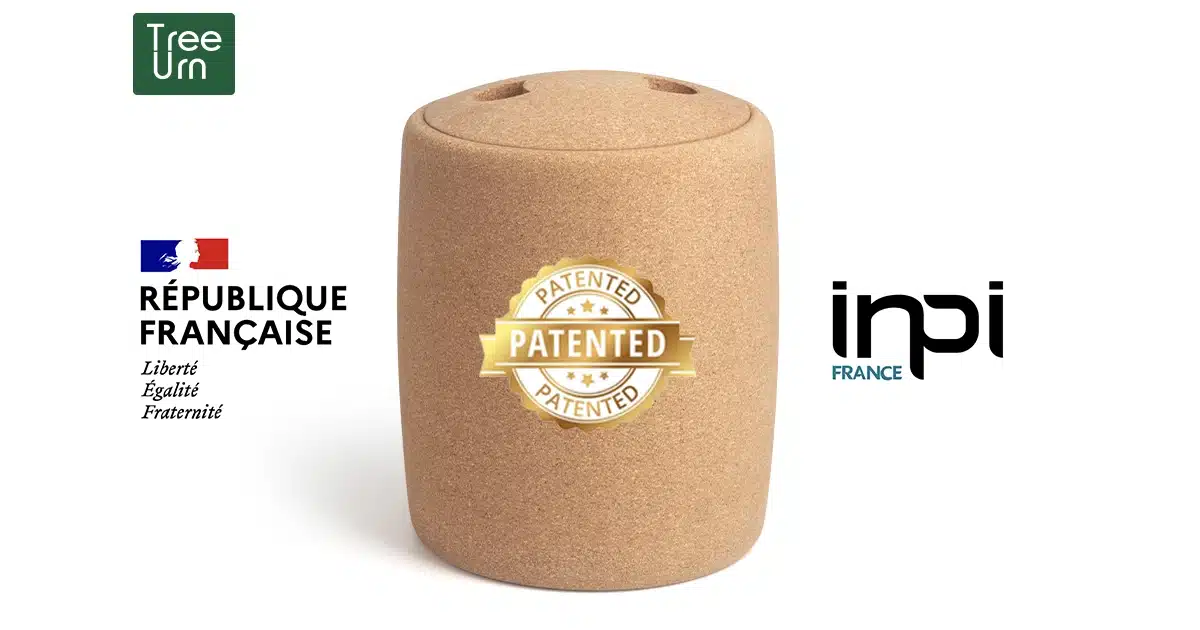
Tree-Urn was born from these values, and its recognition as a patented innovation marks a decisive step in the evolution of eco-friendly funeral solutions.
What Does a French INPI Patent Mean?
A patent granted after examination by the French National Institute of Industrial Property (INPI) is much more than a simple administrative formality.
It is the recognition that an innovation is new, distinctive, and structured, and that it brings a meaningful response to an existing need.
For Tree Urn, this first French patent represents the foundation of the entire protection strategy. It establishes a clear priority date and serves as the legal and conceptual basis for international protection.
Beyond its legal scope, this patent reflects a deeper commitment:
to design a solution that is durable, coherent, and responsibly introduced into the funeral ecosystem.
From a National Patent to an International Vision
Following this first step, an international filing was made under the PCT (Patent Cooperation Treaty) framework administered by WIPO.
This approach allows innovators to preserve their rights at a global level while carefully preparing the future deployment of their solution.
At this stage, Tree Urn’s strategy remains intentionally measured and discreet.
Innovation in the funeral sector requires time, cultural sensitivity, and respect for the diversity of legal and ethical frameworks worldwide.
What matters most is not the number of territories covered, but the consistency of the vision carried forward.
Rethinking Funeral Practices for a Changing World
Tree-Urn is not merely an object.
It is a response to profound transformations affecting our relationship with death, funeral practices, nature, and memory.
An Ecological Imperative
Traditional funeral practices often rely on materials and processes with a heavy environmental footprint.
Tree Urn proposes an alternative rooted in biodegradability, natural cycles, and regeneration.
By allowing a tree to grow from the ashes, the act of farewell becomes a gesture aligned with life itself — not a symbolic promise, but a tangible ecological transition.
This approach speaks to a growing awareness:
how we die also shapes the world we leave behind.
Space, Land Use, and Future Constraints
Cemeteries across many regions are facing saturation. Urban density, land scarcity, and long-term maintenance raise complex questions for communities and institutions.
Tree Urn introduces a model that naturally reduces the demand for burial space:
- no permanent monument,
- no permanent structure,
- no land permanently dedicated to burial.
The tree becomes part of the landscape, not an object to be maintained, but a living presence integrated into nature.
A Psychological Shift in the Relationship with Death
Perhaps the most profound dimension of Tree Urn lies in its psychological impact.
For many families, grief is not only about remembrance — it is about finding meaning, progress, and release.
Tree Urn proposes a different ritual:
• receiving the urn,
• expressing thoughts and emotions,
• planting the tree,
• letting go.
The focus is not on creating a lasting place of attachment, but on allowing life to continue independently.
The tree lives on its own.
The memory transforms.
This shift helps reframe death not as an endpoint frozen in stone, but as a transition that reconnects us with life.
Read: all about Tree Urn
Innovation, Trust, and Long-Term Responsibility
When faced with something new, doubt is natural — especially in a field as sensitive as funerary practices.
That is precisely why Tree Urn chose a path of patented innovation, transparency, and institutional rigor.
The patent reflects a commitment to rigor, continuity, and long-term responsibility
It is a signal of seriousness, of commitment to doing things properly, and of respect for families, professionals, and future generations.
Tree Urn does not seek to disrupt funeral traditions abruptly.
It seeks to offer a meaningful alternative, grounded in nature, psychology, and responsibility.
Looking Forward
The future of funerary practices will be shaped by coherence.
By solutions capable of integrating ecological realities, land-use constraints, and human emotions into a single, respectful gesture.
Tree-Urn is one step in that direction —
by offering a patented solution that enables the growth of a tree from cremation ashes, providing a simple and ecological way to rethink our approach to death.

איפה ניתן לשתול עץ.
לתוך הקלפי.