
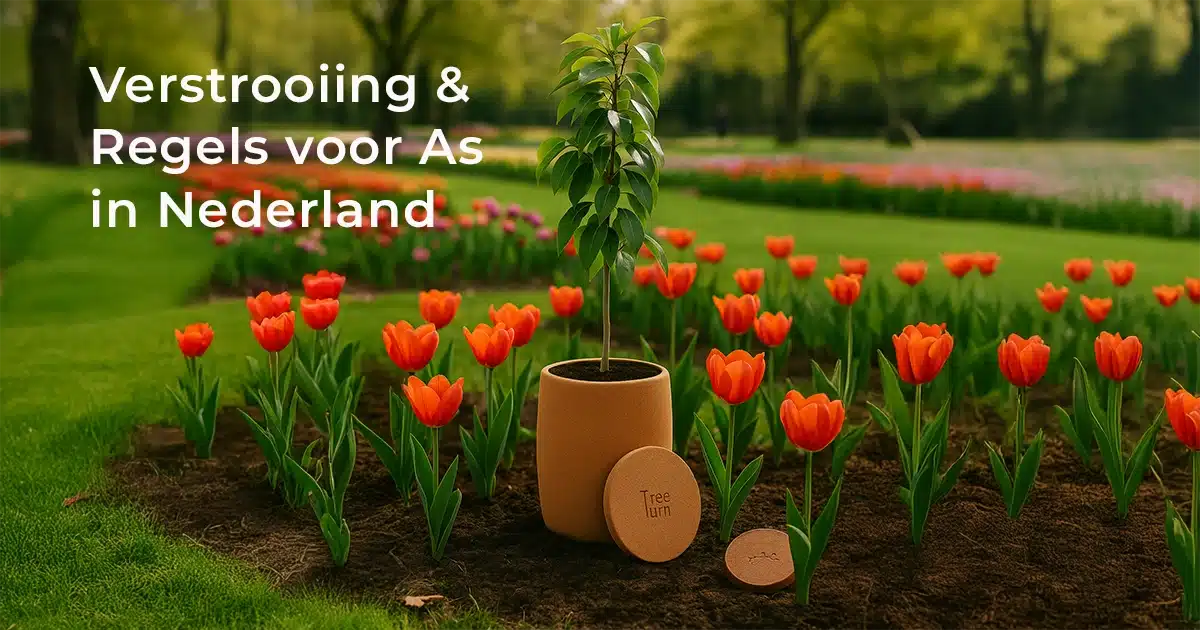
The Netherlands is one of the most flexible states in Europe when it comes to the final destination of ashes. Families can choose among several legal options for scattering and memorialisation, as long as they follow the national and municipal regulations. Below is an overview of the key rules for humans and pets, along with ecological alternatives such as the Tree Urn.
Cremation and Legal Framework
- Cremation must take place in a certified crematorium.
- Ashes must remain at the crematorium for one month before they can be collected or scattered. An exemption may be granted in exceptional cases.
- After this period, families are free to decide on the destination of the ashes.
- By law, cremation may not take place earlier than 36 hours after death and no later than six working days afterwards.
👉 For complete legal details, consult the official Dutch government portal:
Rijksoverheid.nl – Burial and Cremation Rules
Scattering Ashes in the Netherlands
- Scattering is allowed but only in authorised locations, such as municipal scattering fields, memorial gardens, forests, or natural reserves.
- Permission from the local municipality is required, and some charge a fee. The amount can vary widely depending on the location.
- Scattering at sea is possible, provided the rules of the relevant municipality and maritime authorities are respected.
Tree Urn: An Eco-Friendly Alternative
Among the scattering options, biodegradable urns such as Tree Urn offer families a symbolic and ecological choice:
- The urn decomposes naturally in the soil over approximately eight years.
- During this time, it gradually releases the ashes, which naturally balance and evacuate excess alkalinity, preventing harm to the surrounding soil.
- Because the ashes return to nature progressively, this practice is regarded as a form of scattering rather than burial.
- Families also have the option to plant the urn in a pot, making it possible to keep the memorial tree close while still respecting ecological principles.
👉 If you want to learn more about how Tree Urn works as a biodegradable and compostable funeral urn, read our dedicated article here
Regulations for Pets
In the Netherlands, families also have options for their pets:
- Private burial in the garden is allowed if certain conditions are respected: the grave must be at least one metre deep, the pet should not be wrapped in plastic, and local municipal rules must be observed.
- Important note for Tree Urn: this one-metre depth requirement does not apply, since the urn is biodegradable and decomposes over eight years, releasing ashes progressively while naturally neutralising the soil.
- Owners can also choose pet cremation, either individual (with the return of the ashes in an urn) or collective (without ashes being returned).
- Pet crematoriums across the country, such as those in The Hague region, offer services including farewell ceremonies and memorial urns.
Summary Table
| Category | Rules & Options |
|---|---|
| Humans | One-month storage at crematorium; scattering in authorised sites only |
| Scattering Locations | Municipal fields, memorial gardens, forests, sea; municipal approval required |
| Tree Urn | Biodegradable urn + tree, decomposes in 8 years, recognised as scattering |
| Pets | Garden burial under conditions; Tree Urn exempt from 1 m depth rule; cremation services available |
Conclusion
The Netherlands provides families with flexible and respectful solutions for the final destination of ashes. From scattering in dedicated areas to innovative eco-friendly urns like Tree Urn, the law ensures that ashes can return to nature in a dignified way.
For pets, both garden burials and cremation services are available. With Tree Urn, owners can also choose a biodegradable urn that slowly integrates into the earth or can be planted in a pot, creating a lasting and ecological memorial for their beloved companions.
👉 For an overview of scattering ashes across Europe, visit our dedicated guide:
treeurn.eu – Ash Scattering in Europe
👉 In the Netherlands, Tree Urn is available through our official distributor DE VENE. Discover more in their presentation video: Watch here.
Learn more about this eco-friendly option: Tree Urn.
FAQ — Scattering and Tree Urn in the Netherlands
1) Is scattering ashes legal in the Netherlands? Yes. Scattering is permitted in authorised locations under national law and municipal rules. Always confirm the local municipality’s conditions before planning.
2) How long must ashes stay at the crematorium? By law, ashes remain at the crematorium for one month before collection or scattering. An exemption may be granted in exceptional cases.
3) When can cremation take place? Cremation cannot occur earlier than 36 hours after death and must take place within six working days, unless an official exemption is granted.
4) Where can we scatter ashes? In municipal scattering fields, memorial gardens, forests/nature reserves, and at sea, provided the site is authorised and local rules (and any fees) are respected.
5) Do we need municipal permission? Yes, for most public locations. Municipalities set site rules, time windows, and fees; requirements vary by locality.
6) Is sea scattering allowed? Yes. It must follow maritime and municipal guidance; licensed operators are commonly used and may handle the permits.
7) Is a biodegradable tree urn (Tree Urn) considered scattering? Generally yes. Because the urn decomposes and releases ashes gradually into the soil over about eight years, it is treated as a form of scattering rather than a permanent burial.
8) Can we plant Tree Urn in a planter? Yes. A large planter with drainage lets you keep the memorial close while respecting ecological principles; refresh the substrate over time.
9) What about garden burial for pets? Private-garden burial is allowed subject to conditions (e.g., depth, no plastic, local rules). Tree Urn’s biodegradable design supports a gradual, soil-safe integration of ashes.
10) Are pet cremation services available? Yes. Individual cremation (ashes returned) or collective cremation (no return) are widely available via dedicated pet crematoria.
11) Why does Tree Urn decompose over ~8 years? The medium-term timeline protects young roots, moderates the alkaline release of ashes, and enriches soil as the urn turns to humus.
12) Where can I learn the official rules? See the Dutch government portal on burial and cremation, and check your municipality’s website for local scattering regulations and fees.
0 Comments