
Tree-Urn & Simplified Legal Framework (France)
Understand where and how Tree Urn can be used in full compliance with French law for human ashes.
For companion animals, no funeral law applies — families are entirely free to choose the location and the ritual they prefer.
Quick navigation:
1. What French law actually says (in plain language)
Since the law of 19 December 2008, ashes have a legal status equivalent to that of a body.
Their final destination is strictly governed by Article L.2223-18-2 of the Code général des collectivités
territoriales (CGCT).
According to this article, ashes must be:
- Buried in a grave or placed in a columbarium niche, or
- Scattered in a dedicated area within a cemetery (a “jardin du souvenir”), or
- Scattered in nature, outside public roads.
Since 2008, keeping an urn at home is forbidden. The urn and the ashes must receive one of the destinations listed above.
2. Biodegradable urns: a clear legal framework
The official Funeral Guide explains that there is currently no regulation that defines or certifies the “biodegradability” of an urn.
However, it clearly states that a biodegradable urn may be used for:
- Scattering in nature,
- Immersion in the sea or in a non-navigable river or body of water,
- Burial in open ground (full contact with soil).
The Ministry’s guide specifies that burying a biodegradable urn in the ground can be treated
as scattering the ashes. Because scattering is considered final, the urn is not meant to be exhumed.
3. Burial = scattering (legally)
The key point is this: burying a biodegradable urn in the earth is treated as an act of scattering.
Legal consequences of this qualification:
- No funeral concession is created.
- No funeral monument is recognised in law.
- No funeral rights are attached to the land.
- The urn is not intended to be exhumed; the act is definitive.
- If an urn contains a young tree (as with Tree Urn), that tree is regarded as a
symbolic living marker, not as a legal grave.
4. Where Tree Urn fits in this framework
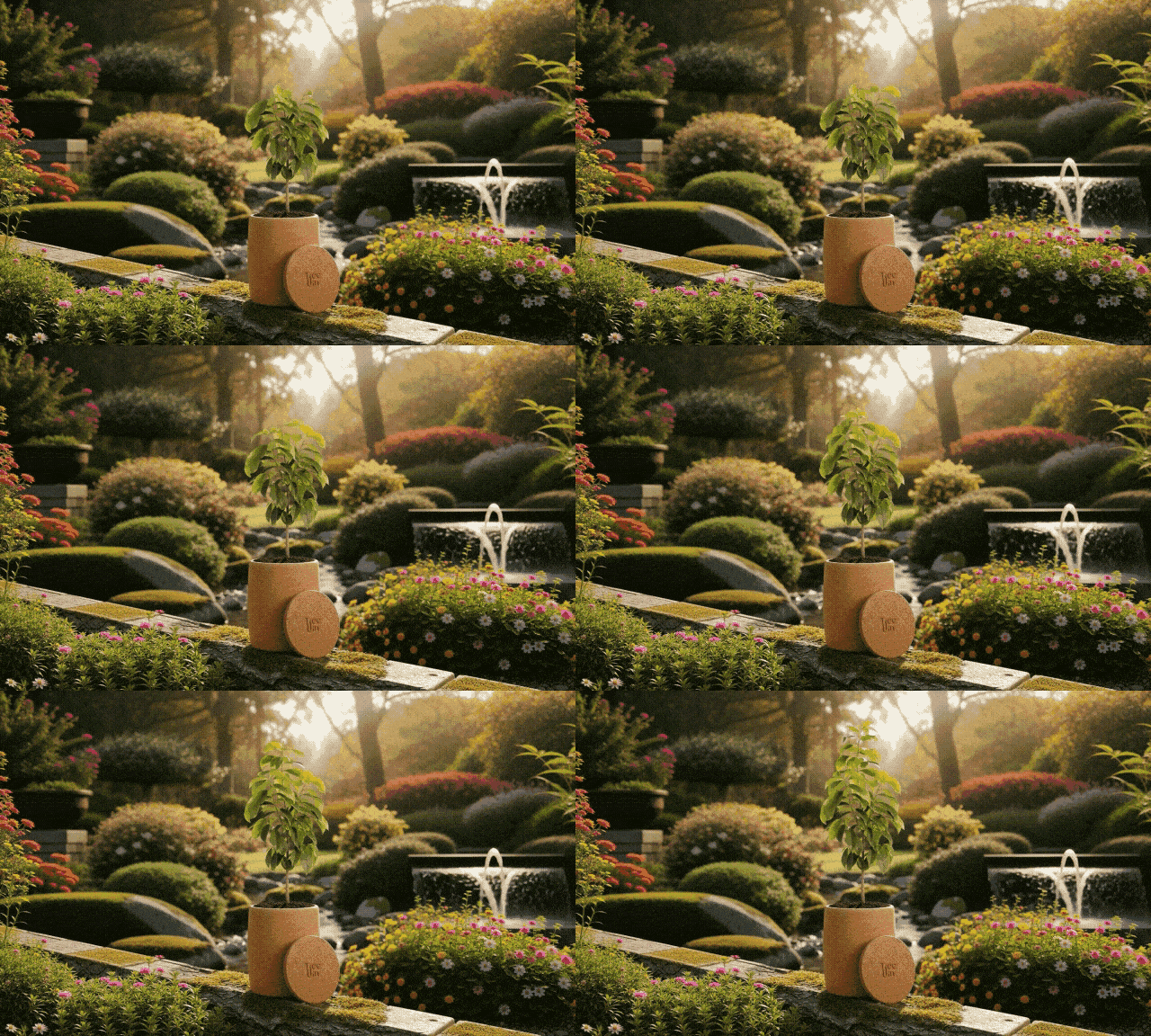
Tree Urn is a biodegradable cork urn containing a young tree. Once placed in the ground,
the urn gradually breaks down and the ashes merge with the soil.
From a legal perspective, this process is considered a form of scattering by burial of a biodegradable urn, not a “traditional burial” in the sense of a coffin or a permanent grave.
Therefore, Tree Urn falls strictly under the category of:
“Scattering in nature via burial of a biodegradable urn.”
It does not fall under:
- Burial in a classical family plot,
- Placement in a columbarium niche,
- Placement in a cemetery vault or a “cavurne”,
- Any system involving a permanent funeral monument.
5. Where Tree Urn can be planted (legally safe use)
To avoid legal grey areas, Tree Urn is only associated with categories that are
explicitly recognised in French law and case-law:
- Scattering in nature,
- Natural private land (not landscaped as a cemetery or a domestic graveyard),
- Never in a “jardin du souvenir”,
- Never in cremation gardens or other cemetery structures,
- Never in private gardens of dwellings described as residential yards.
5.1 Planting allowed: in nature
The notion of “nature” is not strictly defined in legislation, but French administrative courts
and the official guides generally consider it to mean non-built, non-urbanised natural environments, such as:
- Forests,
- Meadows and fields,
- Natural, uncultivated land,
- Mountain areas,
- Natural coastal areas (outside developed beaches and promenades),
- Large, non-urbanised private estates, with the landowner’s consent.
In these places, scattering is permitted. Tree Urn can therefore be planted there as a mode of scattering in nature.
Legal obligations remain the same as for any scattering in nature:
- Owner’s consent if the land is private (fields, woods, natural estates, etc.),
- Official declaration of scattering to the town hall of the deceased’s place of birth,
as required by Article L.2223-18-3 of the CGCT.
5.2 Planting allowed: on natural private land
Tree Urn can also be planted on private land that is natural ground and not developed as a cemetery:
for example, a private woodland, a rural plot or a family-owned piece of agricultural or wild land.
Conditions for legal use:
- The soil must be natural (earth in contact with roots and ashes).
- No stone base, no slab, no permanent structure may be built.
- The land must not be turned into a private cemetery or unofficial graveyard.
- Written consent from the landowner is strongly recommended.
- The act is treated as scattering, not as a burial creating a grave or funeral rights.
As with scattering in nature, the declaration to the town hall of the place of birth remains
mandatory.
5.3 Why Tree Urn is not used in remembrance gardens or cemeteries
Tree Urn is not used in “jardins du souvenir” or cremation gardens, not because it is “forbidden” as such,
but because these spaces are not designed for it.
- Remembrance gardens are designed either to scatter ashes directly on the ground,
or to host standard urns placed at the foot of an existing tree or in dedicated plots. - Cemetery cremation areas are designed for classic urns (non-biodegradable or not destined
to disappear) placed in columbaria, vaults or marked concessions.
Tree Urn, as a biodegradable urn containing a growing tree, does not match these infrastructures.
It belongs to a different logic: scattering in nature on natural land.
5.4 Why Tree Urn is not presented for use in domestic gardens
French law does not recognise a specific category of “domestic garden” for the destination of ashes.
Private gardens attached to dwellings often contain built structures, terraces, paved areas and other
features that can make the legal situation ambiguous, especially if the area starts to resemble a private grave or cemetery.
To avoid any confusion or legal risk, Tree Urn is therefore not promoted as a solution for planting in residential gardens,
but only on natural private land or in nature under the conditions described above.
6. Tree-Urn is not a funeral monument
Because Tree Urn uses the legal category of scattering in nature, it does not create:
- Any funeral concession,
- Any legally recognised grave or tomb,
- Any funeral rights attached to the land,
- Any obligation for the municipality to maintain the site,
- Any right to exhumation or transfer of remains.
The tree that grows from Tree Urn can of course become a personal place of remembrance, where family and friends may gather.
However, it is not an official memorial site in the eyes of French law.
It is a symbolic living marker, not a funeral monument.
Final summary for families
- Tree Urn is fully compatible with French funeral law.
- Legally, it falls under “scattering in nature” through the burial of a biodegradable urn.
- It can be planted:
- In nature (forests, meadows, natural land) under the usual conditions for scattering,
- On natural private land with the owner’s consent.
- It is not used in remembrance gardens, cemetery cremation areas or domestic dwelling gardens.
- Tree Urn is not a funeral monument, but a gentle, ecological ritual that helps turn grief into a living, growing presence.
Read 👉 Legal guide on French regulations on ashes and funeral urns
0 Comments