
Table of Contents
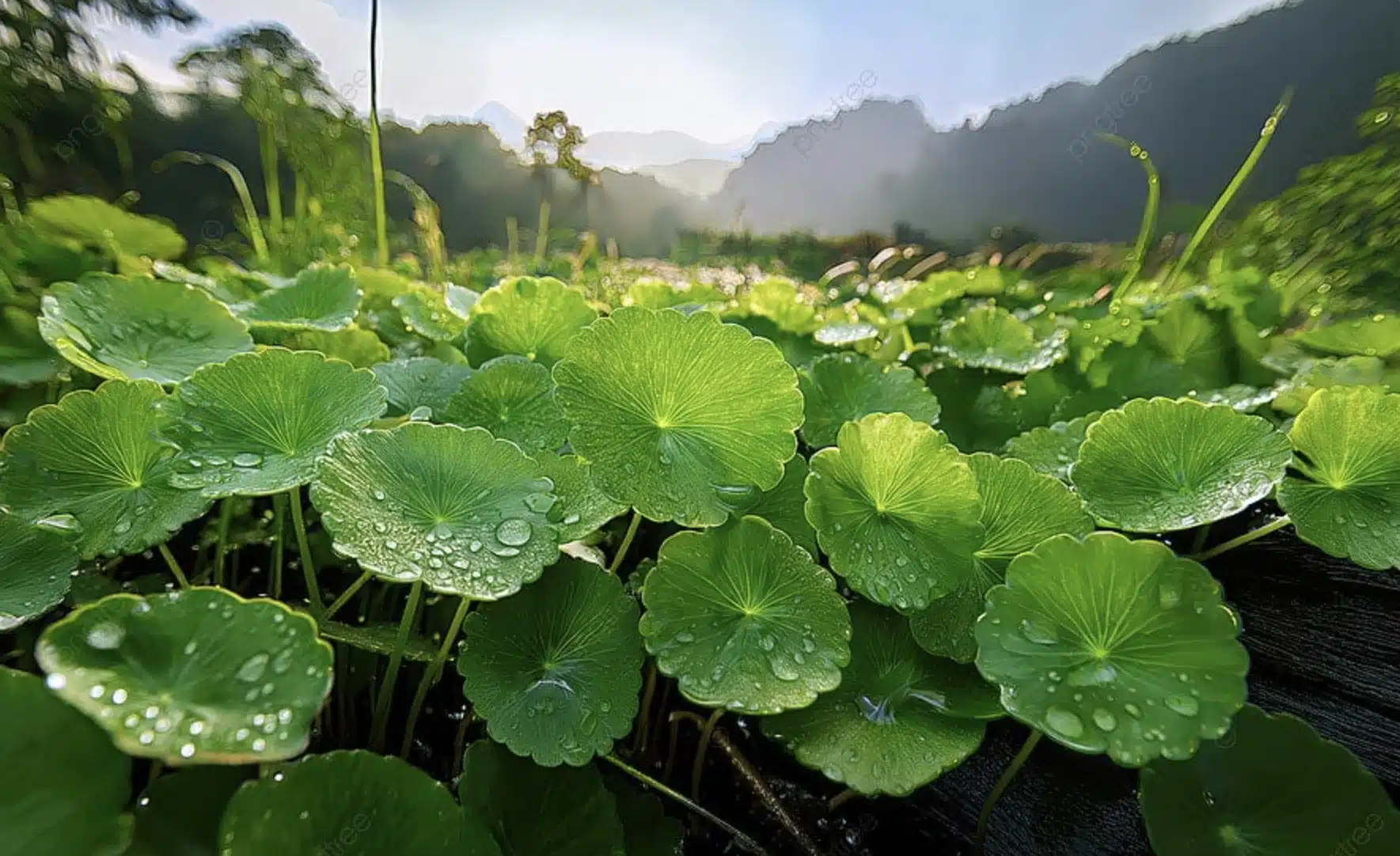
Some plants travel through millennia without fanfare, carried by the hands of generations of healers, mothers, and gardeners. Gotu Kola — known scientifically as Centella Asiatica — is one of them. Discreet, low-growing, with small round leaves shaped like kidneys, it spreads along stream banks, in rice paddies, and on shaded roadsides across Southeast Asia. And yet, what this humble herb accomplishes inside our cells is remarkable.
A Plant with a Thousand Names, a Millennial Wisdom
Centella Asiatica carries as many names as the cultures it has passed through. In India, it is called Brahmi or Mandukaparni. In Indonesia, Pegagan. In the Western world, it is known as Gotu Kola. Folklore has also given it the poetic nickname “tiger herb” — because injured tigers were observed rolling in its leaves to help their wounds heal.
Its presence in ancient texts is well documented. It appears in the Shruta Samhita, one of the oldest Indian medical texts, and forms part of the Vedic tradition going back thousands of years. In China, it has been mentioned as one of the “elixirs of longevity” for over 2,000 years. In Sri Lanka, a popular proverb still says today: “Two leaves a day keep old age away.” In many Asian families, Gotu Kola is not a medicine — it is simply food, consumed daily as a natural part of nutrition.
Botanical note: Centella Asiatica goes by many regional names — Brahmi and Mandukaparni (India), Pegagan (Indonesia), Gotu Kola (Western world), Hydrocotyle (some regions), Tiger herb (folklore). This diversity of names has historically fragmented scientific research on the plant: different studies referenced it under different identities, slowing the accumulation of unified knowledge.
What This Small Leaf Contains
Gotu Kola does not contain collagen. What it does contain are triterpene compounds of remarkable precision. The four most active molecules are:
- Asiaticoside
- Madecassoside
- Asiatic acid
- Madecassic acid
These molecules do not merely supply raw materials to the body. They communicate directly with cells. They activate, stimulate, and regulate — working at the level of cellular signalling rather than simple nutrition.
Action on the Skin: Awakening the Fibroblasts
Collagen is the structural protein that keeps our skin firm, supple, and hydrated. It is produced by specialised cells called fibroblasts, located in the dermis. With age — as early as the mid-twenties — these cells slow their activity and produce progressively less collagen each year.
This is where Gotu Kola intervenes. Its triterpenes act on a cellular signalling pathway known as TGF-beta/Smad, a system that controls tissue growth and repair. By activating this pathway, asiaticoside and madecassoside send a clear signal to fibroblasts: produce collagen — specifically type 1 and type 3 collagen, the most abundant structural proteins in human skin, which together provide structure and elasticity.
A study evaluated by the European Medicines Agency found that at 50 mg/ml of Centella Asiatica extract, collagen production in fibroblasts was multiplied by 3 compared to untreated cells. A clinical trial testing a 10% Gotu Kola cream measured an average collagen increase of 77.89%, alongside a skin hydration improvement of 81.58%.
A randomised, double-blind clinical trial conducted on human subjects documented significant and measurable improvements across five skin parameters: wrinkles, suppleness, firmness, roughness, and hydration. Another study of 60 people with cellulite, who applied a Gotu Kola preparation four times a day for four months, observed significant improvement in 85% of participants.
The Double Protection
Asiatic acid has also demonstrated the ability to inhibit matrix metalloproteinases (MMPs) — the enzymes that break down existing collagen under the effects of sun exposure and ageing. Gotu Kola therefore acts on two fronts simultaneously: stimulating the production of new collagen while protecting what is already present. This dual action sets it apart from approaches that only add raw materials without addressing collagen degradation.
A Tonic for the Brain
Ayurvedic tradition has long regarded Gotu Kola as a brain tonic, and contemporary research is now seriously validating this reputation. Studies show that the plant offers neuroprotection through several mechanisms: enzymatic inhibition, protection against the formation of amyloid plaques implicated in Alzheimer’s disease, protective action against dopamine neurotoxicity in Parkinson’s disease, and reduction of oxidative stress in brain cells.
Gotu Kola also appears to accelerate nerve regeneration and repair. Improvements have been observed in learning, memory, reaction time, and working memory across multiple studies. Research has even explored its potential in children for supporting concentration and cognitive function over time.
Clinical note: A 2016 study compared the effects of Gotu Kola extract and folic acid on cognitive function following stroke, evaluating three groups — 1,000 mg of Gotu Kola per day, 750 mg per day, and 3 mg of folic acid per day. This opens promising avenues in post-stroke cognitive recovery research.
Circulation and Wound Healing
The triterpenes in Gotu Kola strengthen blood vessel walls and improve the integrity of connective tissue throughout the vascular system. European physicians have prescribed Centella Asiatica extracts to treat chronic venous insufficiency, varicose veins, and circulatory problems in the lower limbs.
In terms of wound healing, the plant displays a remarkable characteristic: it stimulates collagen synthesis in damaged tissue without triggering overproduction — avoiding the fibrosis or excessive scarring that can result from poorly regulated repair. Studies have confirmed that collagen synthesis increases in damaged areas while excessive production, as observed in fibrosis, is avoided when Centella is used. This regulated repair profile makes it a genuinely valuable ally in tissue regeneration.
Growing Gotu Kola at Home
One of Gotu Kola’s greatest qualities is how easy it is to grow. The plant is a perennial, creeping, low-growing herb that produces tiny pink flowers in summer beneath its characteristic kidney-shaped leaves, roughly 5 cm in diameter. It reaches a maximum height of around 20 cm.
Ideal conditions include partial shade to full sun, moist to wet soil — it thrives near streams, in boggy areas, and in cool shaded spots — and mild to warm temperatures corresponding to USDA hardiness zones 8 to 12. In cooler regions, it can be grown in pots indoors or brought inside before winter. A pot with good moisture-retaining compost and frequent watering is all it needs. In summer, daily watering may be necessary: the plant wilts quickly in dry conditions but recovers just as fast once watered.
Propagation is remarkably simple. Like strawberries, Gotu Kola produces stolons — long creeping stems that root at each node and generate daughter plants. Simply take a rooted section and transplant it. A single starter plant can quickly become an unlimited and self-renewing supply.
Important: In warm, humid climates, Gotu Kola can become invasive. It has naturalised in Hawaii and colonised wetland areas in China. Growing it in a container is often the wisest approach to keep the plant under control. The more you harvest, the more the plant branches and produces new leaves — cutting is a form of care.
How to Use Gotu Kola
The leaves of Gotu Kola are edible. Their flavour is slightly bitter with a gentle sweetness and notes reminiscent of parsley or celery. Across Asia, they appear in a wide range of traditional preparations. In Sri Lanka, they are prepared as a salad with coconut and spices, known as gotu kola sambola. In Vietnam, they are added to spring rolls. In Indonesia, they are blended into fresh drinks.
In everyday use, 2 to 3 fresh leaves per day in a salad represent the simple traditional dose. As a tea, steep 1 to 2 teaspoons of dried leaves (5 to 10 g) in approximately two-thirds of a cup of boiling water for 10 to 15 minutes; three cups per day are generally suggested. As dried powder in capsules, a typical dose is 600 mg per day, or 300 to 680 mg taken three times a day. As a standardised extract, 60 mg once or twice a day, containing up to 100% triterpene saponins, is commonly used in modern phytotherapy.
Clinical studies have used doses ranging from 60 to 450 mg of extract per day. Consistency appears to matter more than intensity: the herb works through a cumulative effect, building gradually over time.
Precautions
Gotu Kola is a well-tolerated plant, but a few precautions are worth knowing:
- Liver: the plant is metabolised by the liver. In cases of existing liver conditions, consult a healthcare professional before use. High doses over extended periods have, in rare cases, been associated with liver issues. Cycling use — for example, five weeks in seven — may be a prudent approach.
- Pregnancy and conception: women who are pregnant or trying to conceive should avoid the plant. Traditional use includes contraceptive applications, and this mechanism is not yet fully understood.
- Topical handling: some people experience mild skin irritation when handling fresh leaves. Test a small area before extended use.
- Allergies: allergic reactions are possible, though uncommon.
A Plant Worth Preserving
The growing global interest in Gotu Kola has led to overexploitation of wild populations. The plant also presents naturally low seed viability and germination rates, further weakening natural stocks. Growing your own Gotu Kola is therefore a doubly meaningful gesture: for your own wellbeing, and for preserving a species that millennia of traditional use never exhausted, but that a few decades of industrial collection could threaten.
In this sense, cultivating Gotu Kola at home is not only a personal health choice — it is a small act of ecological responsibility, entirely in keeping with a relationship of respect and reciprocity with the living world.
In Closing
Gotu Kola is a plant of quiet generosity. It makes no grand promises. It grows, spreads, offers its leaves — and through them, molecules whose full scope science is only beginning to measure. Stimulating collagen production from within. Protecting neurons. Supporting circulation. Promoting the healing of tissue. Accompanying memory and concentration. All of this from a single small creeping herb, known for three thousand years by those with the wisdom to observe it closely.
The plant has not changed. It is our ability to see it that continues to grow.
0 Comments