
In this article
Discover our biodegradable urns →
After cremation, one of the first decisions a family faces is what to do with the ashes. That question often begins with choosing an urn — but not all urns are the same. They differ in material, symbolism, relationship to time, and what they ultimately leave behind.
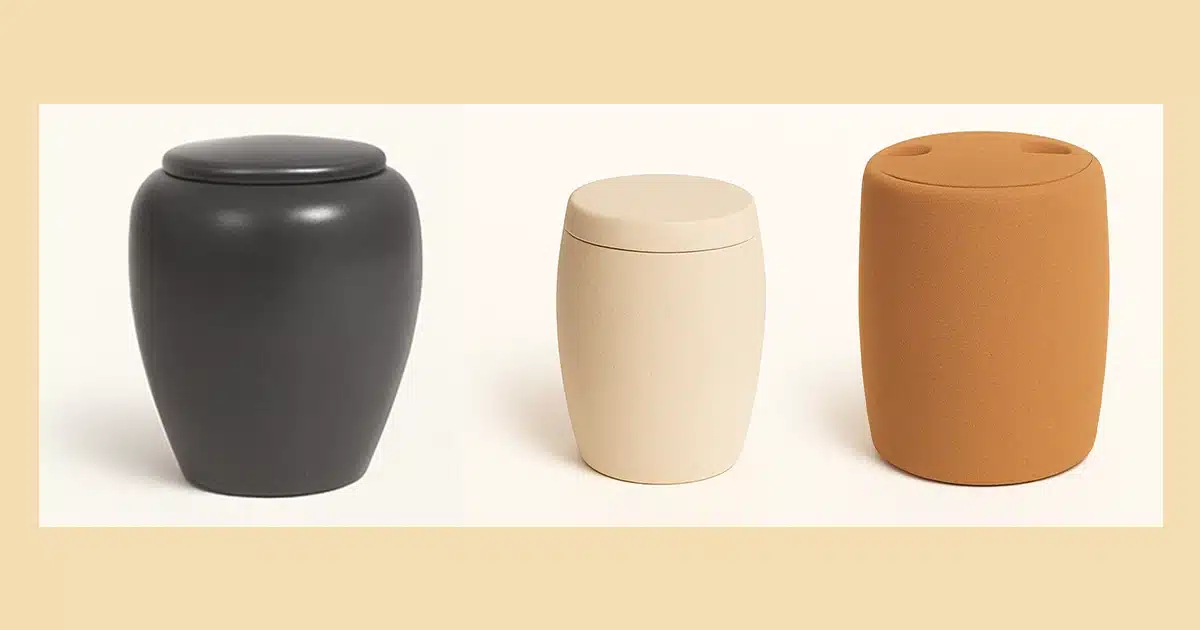
This guide compares the three main categories available today: classic ceramic or metal urns, standard biodegradable urns, and the Tree Urn — a medium-term biodegradable cork urn designed to support the growth of a living tree. The goal is not to recommend one over another, but to help each family understand what each choice truly means.
“Choosing an urn is not simply a practical decision. It is one of the first gestures of mourning — and it carries meaning.”
1. The three main options after cremation
When it comes to urns, three distinct categories have emerged in response to changing attitudes towards death, ecology, and memory.
Classic urns — most often made from ceramic, marble, metal, or wood. Designed to last indefinitely, they are the traditional choice: a permanent vessel for the ashes, kept at home or placed in a columbarium niche.
Standard biodegradable urns — made from plant fibres, compressed sand, paper, or water-soluble materials. Designed to decompose within one week to twelve months, they allow ashes to return to the earth or water quickly.
The Tree Urn — made from cork and a biodegradable binder, and designed to decompose over 6 to 8 years. Unlike a standard biodegradable urn, it is not simply a container to discard — it is an active part of a living memorial. Buried with a young tree or plant, it nourishes the roots progressively as it breaks down, moderating the alkalinity of the ashes to protect the tree during its critical establishment phase.
2. Comparison table
| Criteria | Classic Urn (ceramic / metal) | Standard Biodegradable | Tree Urn (cork, 6–8 years) |
|---|---|---|---|
| Material | Ceramic, metal, marble or wood | Plant fibres, sand, paper, or soluble materials | Cork and biodegradable binder |
| Decomposition | None — permanent | 1 week to 12 months | 6 to 8 years — gradual |
| Symbolism | Fixed memory, preservation | Simple return to nature | Renewal: from loss grows a living tree |
| Relationship to time | Unchanging — can become difficult to live with over time | Disappears quickly — memory may feel cut short | Gradual transformation — respects the rhythm of grief |
| Ecological impact | None — no return to nature | Positive — rapid return to earth or water | Positive — active contribution to tree growth |
| What remains | The urn, indefinitely | Nothing visible after decomposition | A living tree |
| Emotional comfort | Can reassure — but primarily reminds of absence | Soothing through the ecological gesture — but fleeting | Offers peace and continuity: the tree grows year after year |
| Personalisation | Engraving, colour, material | Limited — temporary by nature | Message or design printed directly on cork — free of charge |
| Legal status | Columbarium or ground burial — formal cemetery process | Scattering — subject to local regulations | Scattering — flexible, no official burial site created |
3. Classic urns: ceramic and metal
The classic urn is the most established choice. Solid, permanent, and often beautifully crafted, it offers a tangible and visible memorial — something to hold, place on a shelf, or deposit in a columbarium niche.
For families who find comfort in having the ashes close by, or who prefer a structured and officially recognised resting place, the classic urn remains the most straightforward option. It requires no additional steps and involves no uncertainty about decomposition or planting.
Its limitation, for some families, is also its defining characteristic: it does not change. The urn remains as it is — which can, over time, feel heavy rather than comforting. There is no living element, no growth, no transformation.
“A classic urn preserves. It holds. For some, that permanence is exactly what they need. For others, it becomes a weight they did not expect.”
4. Standard biodegradable urns
Standard biodegradable urns are designed to dissolve quickly — whether in water (for sea scattering) or in the ground. Their decomposition timeline ranges from a few days to about twelve months, depending on the material and environment.
They are the right choice for families who want a rapid and ecological return to nature — without a permanent object to manage. Simple, lightweight, and respectful of the environment, they leave no trace.
The limitation is the speed itself. For many families, the grief process extends well beyond twelve months. A memorial that disappears within weeks may feel too fleeting — too quick for the emotional reality of loss. And because very rapid decomposition releases the alkalinity of ashes quickly, they are not well suited to supporting a young tree during its establishment phase.
Read our article on the biodegradable and compostable funeral urn →
5. Tree Urn: the medium-term living memorial
The Tree Urn occupies a different position in the landscape of funeral urns. It is not designed to be kept indefinitely, nor to disappear quickly. It is designed to accompany a transition — one that takes the same time as grief itself.
Made from cork and a biodegradable binder, the urn decomposes gradually over 6 to 8 years. During that time, it holds the ashes securely, protects the roots of the young tree planted alongside it, and moderates the natural alkalinity of the ashes — preventing root stress during the critical early years of growth.
What makes this medium-term timeline meaningful is its alignment with human experience. In the first year, the tree is fragile and the family is in active grief. By year three or four, both the tree and the family have found their footing. By year six or eight, when the urn has fully returned to the soil, the tree stands on its own — as does the family.
Under Spanish and most European legal frameworks, this practice is considered a form of ash scattering rather than permanent burial — which gives families significant flexibility in choosing where to plant, without the formalities of a cemetery concession.
“A tree does not grow overnight. Neither does grief heal overnight. The Tree Urn simply honours both truths at once.”
Read our Concept page: How to create a living memorial →
6. Regulations and legal framework
After cremation, the options available to families depend on the regulations applicable in their country, region, and municipality. The rules differ significantly across Europe — and sometimes even between towns within the same country.
As a general principle, classic urns placed in cemeteries follow formal burial regulations. Biodegradable urns and the Tree Urn generally fall under ash scattering frameworks, which are regulated locally. In most European countries, scattering on private land with the owner’s consent is permitted.
Read our guide: Cremation and urn regulations by country in Europe →
7. Frequently asked questions
What are the main types of funeral urns available?
Three main categories: classic urns in ceramic or metal (permanent), standard biodegradable urns (decompose in 1 week to 12 months), and the Tree Urn in cork (decomposes over 6 to 8 years while supporting a living tree).
Why choose a medium-term biodegradation of 6 to 8 years?
It preserves the ashes initially, moderates their alkalinity progressively, and protects the young tree’s roots during the critical establishment phase. The urn then enriches the soil as it fully returns to the earth.
Is a faster biodegradable urn always better?
Not necessarily. A very rapid release can stress a young tree because cremation ashes are alkaline (pH 10–12). A medium-term profile better matches the biology of a young tree’s root development.
What remains after 10 years with a Tree Urn?
Only the tree. The cork urn has fully returned to the earth and become part of the soil’s organic matter.
Can I use a Tree Urn in a pot or on a balcony?
Yes. A large planter with good drainage works well. Refresh the substrate as needed and repot as the tree grows.
How do I choose the right urn size?
Use the metric rule of thumb: volume in litres equals approximately the person’s or animal’s weight in kg multiplied by 0.035. For example, a person weighing 70 kg produces approximately 2.45 litres of ashes — the Tree Urn M is designed for this.
Is Tree Urn only for people?
No. The same process works for companion animals. The Tree Urn S is specifically designed for pets under 10 kg.
Where can I plant a Tree Urn?
In a private garden with the owner’s consent, in a dedicated memorial forest, or in certain natural spaces — subject to local regulations. Always check the applicable rules in your country and municipality.
0 Comments